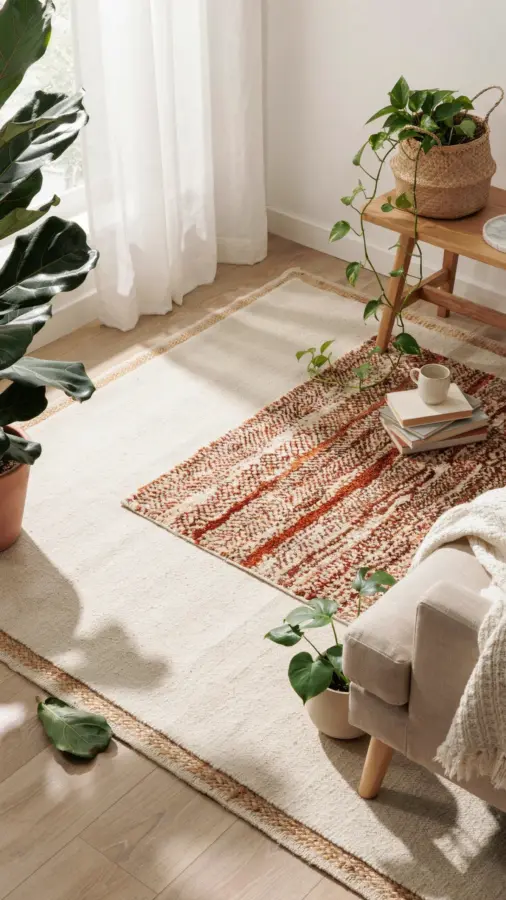
Layered rug styling is one of those decor tricks that looks effortless when done well, but can go sideways fast if you aren’t careful. I have made my fair share of rug layering mistakes – buying rugs that slide around, pairing textures that fight each other, or ending up with a lumpy mess that feels more like an obstacle course than a cozy floor. After trial, error, and a few bruised shins, I want to share the most common blunders and exactly how to avoid them. This guide cuts through the Pinterest perfection and gives you real, practical steps to transform your floor without the frustration.
1. Getting the Size Ratio Wrong Between Your Base and Top Rug
The biggest rookie mistake is grabbing a small accent rug and tossing it on a similarly sized jute or sisal base. If both rugs are close in size, the top rug will either slide off entirely or look like an accidental overlap. You need a clear size hierarchy. The bottom rug should be at least 8 to 12 inches larger on every side than the top rug. For a standard living room layering, try a 5×7 jute as the base and a 4×6 patterned rug on top. This gives enough border to anchor the look, especially with furniture legs resting on the bottom layer. If you have a larger space, consider an 8×10 base and a 5×8 top rug. Avoid using the same dimensions – that just creates a confusing double layer that serves no practical purpose.
2. Ignoring Texture Compatibility (and Ending Up with a Slippery Mess)
Another mistake I see often is layering two rugs with similar smooth textures, like a flatweave cotton over a flatweave wool. Without enough grip, the top rug will shift every time someone walks over it. You need a base rug with some grip or natural texture – think a chunky jute, sisal, or a tight berber. The top rug can be anything from a shag to a low-pile vintage design. The key is that the bottom rug provides friction. If you absolutely must use a smooth base, add a non-slip rug pad between the layers. But honestly, choosing a coarse natural fiber for the base solves the sliding problem instantly and adds that warm, organic feel that makes layered rug styling so appealing.
3. Forgetting to Secure the Top Rug in High Traffic Spots
Kitchen entries, hallways, and the middle of a busy living room can turn your carefully layered rug combination into a tripping hazard. I learned this the hard way – my kids ran through the hallway and sent the top rug skidding into the wall. The fix is simple but often overlooked: use a thin, grippy rug pad under the top rug as well, not just under the base. For hallways, I recommend double-sided carpet tape on the corners of the top rug, or rug anchors that stick to the base rug without damaging it. If your bottom rug is a natural fiber like jute, you can also sew a small piece of velcro onto the underside of the top rug. That might sound extreme, but it beats constantly adjusting a sliding rug.
4. Mixing Patterns That Clash Rather Than Compliment
Layering gives you a chance to play with patterns, but too many bold prints competing for attention will make the floor feel chaotic. The common mistake is putting a geometric rug on top of a floral or another geometric pattern with no shared color palette. A safer starting point: let the bottom rug be neutral or tone-on-tone. Then pick a top rug with one or two accent colors that you already use in the room. For example, a natural jute base works beautifully under a navy and cream persian-inspired pattern. If you do want two patterns, keep one larger scale and the other smaller – a big stripe under a tight diamond pattern can work if they share a similar hue. Test the combo before buying by laying both rugs side by side in your space, or use a rug layering simulation app.
5. Over-Layering (More Than Two Rugs Without a Clear Plan)
Three or more rugs layered together can look amazing in a maximalist space, but it is a high-difficulty move. The mistake is thinking that simply piling rugs on top of each other equals depth. In reality, you end up with too many edges to catch on furniture feet and a floor that feels lumpy. If you want to use more than two rugs, keep the bottom two very thin and the third one a medium pile. For example, a flat woven dhurrie as the base, a thin cotton kilim in the middle, and a small sheepskin on top for texture. Avoid adding thick shag on thick wool – that creates a soft, unstable surface. A good rule: the top rug should be the softest or most decorative, and every layer underneath should be flatter and more neutral. Less is often more when you are learning.
6. Choosing the Wrong Rug Materials for the Room’s Function
I once layered a beautiful wool shag over a synthetic fiber rug near a dining table. Crumbs, spills, and dog hair became a nightmare. The material compatibility matters just as much as the look. In a living room, a natural
#LayeredRugStyling #RugLayering #InteriorDesignTips #HomeDecorIdeas #AreaRugStyling
Leave a Comment